Abstract
Importance: Cardiovascular disease (CVD) remains the leading cause of mortality worldwide. Robust evidence indicates an association of increased physical fitness with a lower risk of CVD events and improved longevity; however, few have studied simple, low-cost measures of functional status.
Objective: To evaluate the association between push-up capacity and subsequent CVD event incidence in a cohort of active adult men.
Design, setting, and participants: Retrospective longitudinal cohort study conducted between January 1, 2000, and December 31, 2010, in 1 outpatient clinics in Indiana of male firefighters aged 18 years or older. Baseline and periodic physical examinations, including tests of push-up capacity and exercise tolerance, were performed between February 2, 2000, and November 12, 2007. Participants were stratified into 5 groups based on number of push-ups completed and were followed up for 10 years. Final statistical analyses were completed on August 11, 2018.
Main outcomes and measures: Cardiovascular disease-related outcomes through 2010 included incident diagnoses of coronary artery disease and other major CVD events. Incidence rate ratios (IRRs) were computed, and logistic regression models were used to model the time to each outcome from baseline, adjusting for age and body mass index (BMI) (calculated as weight in kilograms divided by height in meters squared). Kaplan-Meier estimates for cumulative risk were computed for the push-up categories.
Results: A total of 1562 participants underwent baseline examination, and 1104 with available push-up data were included in the final analyses. Mean (SD) age of the cohort at baseline was 39.6 (9.2) years, and mean (SD) BMI was 28.7 (4.3). During the 10-year follow up, 37 CVD-related outcomes (8601 person-years) were reported in participants with available push-up data. Significant negative associations were found between increasing push-up capacity and CVD events. Participants able to complete more than 40 push-ups were associated with a significantly lower risk of incident CVD event risk compared with those completing fewer than 10 push-ups (IRR, 0.04; 95% CI, 0.01-0.36).
Conclusions and relevance: The findings suggest that higher baseline push-up capacity is associated with a lower incidence of CVD events. Although larger studies in more diverse cohorts are needed, push-up capacity may be a simple, no-cost measure to estimate functional status.
Conflict of interest statement
Conflict of Interest Disclosures: Dr Zollinger reported being a research consultant with the National Institute of Public Safety Health. Dr Kales reported serving as an expert witness in firefighter cases; and receiving personal fees from Bichler, Kelley, Oliver & Longo, PLLC; McCarthy, Callas & Feeney PC; Macadam, Jury, PA; Sena Polk & Stacy, LLP; and Lichten & Liss-Riordan, PC outside the submitted work. No other disclosures were reported.
Figures
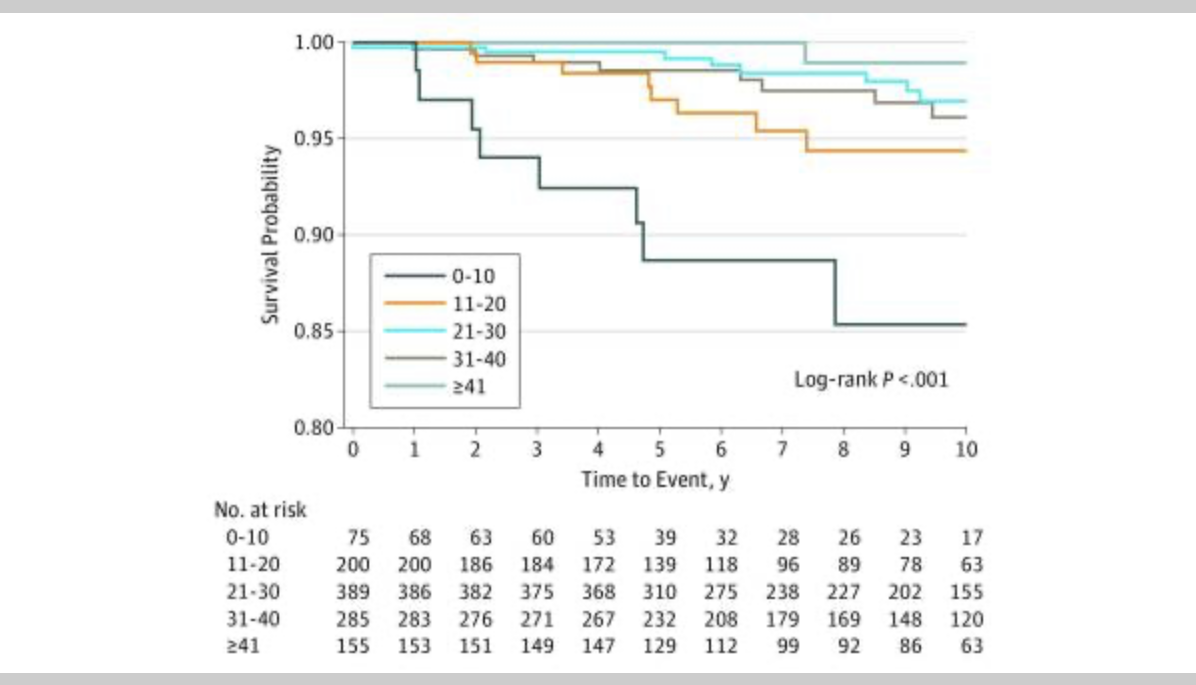
Figure.. Kaplan-Meier Curves for the Cumulative Risk of Cardiovascular Disease Outcome in 5 Push-up Categories Push-up categories are by numbers of push-ups performed during baseline examination.
See this image and copyright information in PMC
Cited by
- Association between Physical Fitness and Cardiovascular Health in Firefighters.
Ras J, Smith DL, Soteriades ES, Kengne AP, Leach L.Ras J, et al.Int J Environ Res Public Health. 2023 May 23;20(11):5930. doi: 10.3390/ijerph20115930.Int J Environ Res Public Health. 2023.PMID: 37297534Free PMC article. - Can cardiovascular health and its modifiable healthy lifestyle offset the increased risk of all-cause and cardiovascular deaths associated with insulin resistance?
Qiu J, Li J, Xu S, Zeng H, Zhang Y, Yang S, Fang L, Huang J, Zhou H, Feng J, Zhan Y, Liu J.Qiu J, et al.Cardiovasc Diabetol. 2025 Mar 10;24(1):114. doi: 10.1186/s12933-025-02674-z.Cardiovasc Diabetol. 2025.PMID: 40065337Free PMC article. - Absolute and Relative Handgrip Strength as Indicators of Self-Reported Physical Function and Quality of Life in Breast Cancer Survivors: The EFICAN Study.
Esteban-Simón A, Díez-Fernández DM, Artés-Rodríguez E, Casimiro-Artés MÁ, Rodríguez-Pérez MA, Moreno-Martos H, Casimiro-Andújar AJ, Soriano-Maldonado A.Esteban-Simón A, et al.Cancers (Basel). 2021 Oct 21;13(21):5292. doi: 10.3390/cancers13215292.Cancers (Basel). 2021.PMID: 34771456Free PMC article. - Athlete's Heart in Asian Military Males: The CHIEF Heart Study.
Liu PY, Tsai KZ, Lima JAC, Lavie CJ, Lin GM.Liu PY, et al.Front Cardiovasc Med. 2021 Sep 29;8:725852. doi: 10.3389/fcvm.2021.725852. eCollection 2021.Front Cardiovasc Med. 2021.PMID: 34660727Free PMC article. - Comparative effectiveness of school-based exercise interventions on physical fitness in children and adolescents: a systematic review and network meta-analysis.
Wu J, Yang Y, Yu H, Li L, Chen Y, Sun Y.Wu J, et al.Front Public Health. 2023 Jun 5;11:1194779. doi: 10.3389/fpubh.2023.1194779. eCollection 2023.Front Public Health. 2023.PMID: 37342273Free PMC article.
References
-
- Benjamin EJ, Blaha MJ, Chiuve SE, et al.; American Heart Association Statistics Committee and Stroke Statistics Subcommittee. Heart disease and stroke statistics-2017 update: a report from the American Heart Association. Circulation. 2017;135(10):-. doi: 10.1161/CIR.0000000000000485 - DOI - PMC - PubMed
-
- Lobelo F, Rohm Young D, Sallis R, et al.; American Heart Association Physical Activity Committee of the Council on Lifestyle and Cardiometabolic Health; Council on Epidemiology and Prevention; Council on Clinical Cardiology; Council on Genomic and Precision Medicine; Council on Cardiovascular Surgery and Anesthesia; and Stroke Council. Routine assessment and promotion of physical activity in healthcare settings: a scientific statement from the American Heart Association. Circulation. 2018;137(18):e495-e522. doi: 10.1161/CIR.0000000000000559 - DOI - PubMed
-
- Labarthe DR, Goldstein LB, Antman EM, et al.; American Heart Association Advocacy Coordinating Committee, Council on Hypertension, Stroke Council, Council on Cardiovascular and Stroke Nursing, Council on Clinical Cardiology, Council on Quality of Care and Outcomes Research, Council on Cardiovascular Surgery and Anesthesia, Council on Functional Genomics and Translational Biology, and Council on Epidemiology and Prevention. Evidence-based policy making: assessment of the American Heart Association’s strategic policy portfolio: a policy statement from the American Heart Association. Circulation. 2016;133(18):e615-e653. doi: 10.1161/CIR.0000000000000410 - DOI - PubMed
For a 55‑year‑old man, “average” capacity is usually quoted around 10–20 consecutive strict pushups in a single set, depending on the standard used.[1][2][3][4][5]
Published benchmarks around age 55
Different groups define “average” slightly differently, but they cluster tightly:
- Mayo‑Clinic‑based guidelines summarized in mainstream articles say that at age 55, men “should be able to do” about 12 pushups in a row.[2][5]
- One performance‑standard table for men lists, for ages 50–59, “average” as 10–19 consecutive pushups, with 20–29 as “good” and 30+ as “excellent.”[3]
- A 2025 strength‑standard article focused on people in their 50s describes “average” for men as 15–20 continuous pushups, 25–30 as above‑average, and 35+ as elite.[4]
- For “55 and older,” one guide breaks scores into: Elite 30+, Above average 20–29, Average 12–19, Below average 6–11, Needs improvement <6.[1]
So if you can hit low‑ to mid‑teens in a single clean set, you’re roughly in the average range for 55; 20–30+ puts you clearly above average for your age.[5][3][4][1]
Sources
[1] Pushup Test After 55: Elite Upper Body Standards https://www.eatthis.com/pushup-test-after-55-elite-rep-standards/
[2] How many push-ups can you do? It's how to test your fitness https://www.standard.co.uk/lifestyle/pushups-mayo-clinic-strength-strong-weights-gym-workout-b1193515.html
[3] How Many Push-Ups Should You Be Able to Do by Age ... - MIKOLO https://gym-mikolo.com/blogs/home-gym/how-many-push-ups-should-you-be-able-to-do-by-age-a-complete-guide-with-charts
[4] If You Can Do This Many Pushups After 50, Your Upper Body Strength Is Elite https://www.eatthis.com/pushups-over-50-elite-strength/
[5] How Pushups can help you age better | Healthy Aging® | health tips https://healthyaging.net/feature-article/how-pushups-can-help-you-age-better/
[6] 55 and still still going strong. If you're over 50 try doing 10 pushups ... https://www.instagram.com/reel/DPoyAQqiPFk/
[7] This is how many push-ups the average person should be able to do, according to experts https://nypost.com/2024/11/11/health/experts-weigh-in-on-how-many-push-ups-the-average-person-should-be-able-to-do/
[8] This 2-Minute Push-Up Test Shows How Strong You Really Are for ... https://www.menshealth.com/uk/building-muscle/a70982566/push-up-test-by-age/
[9] How many push-ups you should be able to do at every age — and when you can use your knees https://nypost.com/2025/03/05/health/how-many-push-ups-you-should-be-able-to-do-at-every-age/
[10] Push-ups by age: Here's how many you should be able to do https://www.foxnews.com/health/push-ups-age-heres-how-many-you-should-able-do
[11] how many push ups is respectable for a grown man - Facebook https://www.facebook.com/groups/538488839906170/posts/2382836432138059/
[12] Push Ups Standards for Men and Women (lb) - Strength Level https://strengthlevel.com/strength-standards/push-ups/lb
[13] How Many Push-Ups Can the Average Person Do? - Lose It! https://www.loseit.com/articles/the-average-push-ups-for-men-women/
[14] How Many Push-Ups After 55 Is Strong? - Eat This Not That https://www.eatthis.com/how-many-push-ups-after-55-is-strong/
[15] How Strong Are You Really? (Try This Over 55 Push-Up Test At Home) https://www.youtube.com/watch?v=jk6BDvU1deo